Before the Buzz: A Quick Rewind
Before smartphones, pockets were lighter and attention spans were heavier. People left home with keys, a wallet, and the kind of blind confidence you now only see in toddlers carrying watering cans.
Silence happened. Frequently.
If you were bored, you made shadow puppets against the wall. Or you stared out the bus window and invented tragic backstories for strangers. We had thoughts that weren’t immediately fact-checked, and emotions that weren’t instantly meme-ified.
You made plans on Wednesday and actually stuck to them on Saturday. Nobody sent a “running 7 mins late” message. You were either there, or you became an urban legend who disappeared after homeroom.
And maps? Oh, we’ll get there. With a left at the Dairy Queen and a hopeful U-turn past the cow pasture.
Finding Places Without Blue Dots
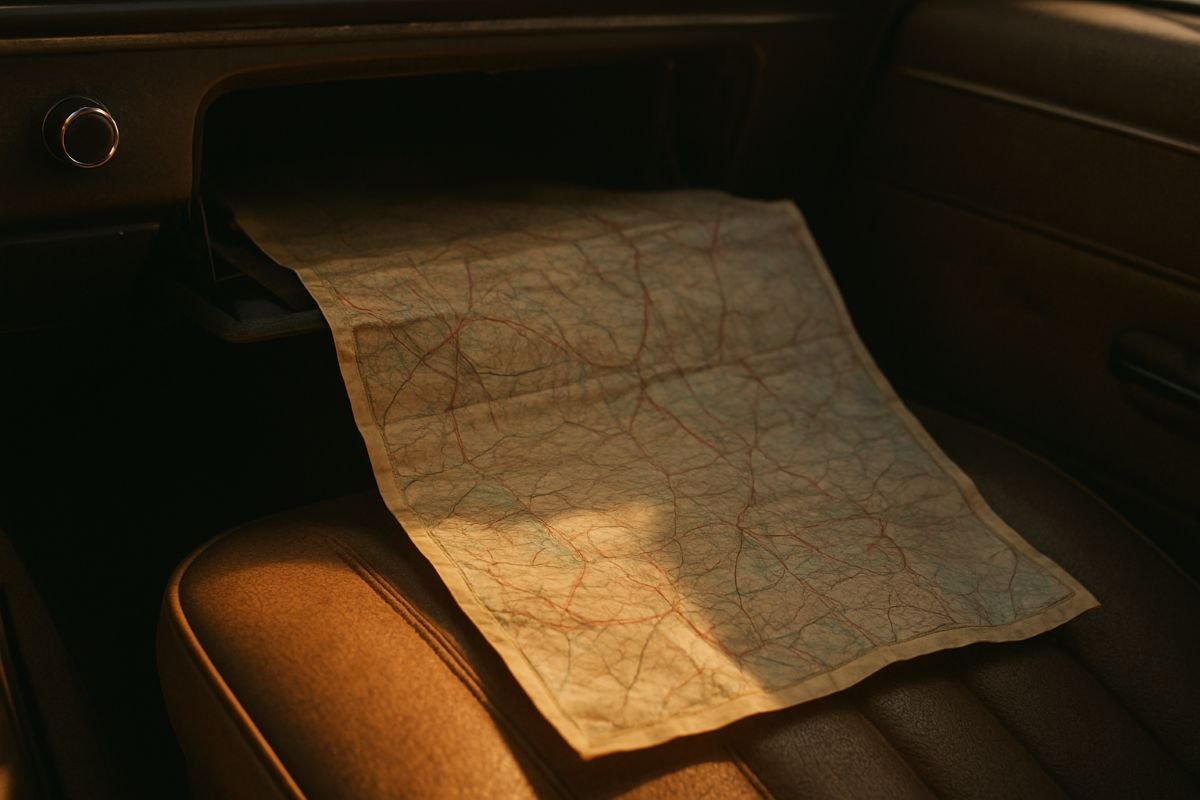
Back then, navigation required eyes, a spine, and faith in road signs. You unfolded a map once and then spent the next 20 minutes refolding it into a crumpled papier-mâché bird.
You asked for directions and received poetry: “Keep straight till the old mill, then hang a right where the road used to be.”
Sometimes you got lost. Sometimes you found a better taco.
Paper Maps, Glove Compartments and Wild Optimism
The glove compartment was a portal to 47 states you would never visit and two gas receipts from 1998. Road atlases reeked of gasoline and ambition. They were also magnets for coffee stains and existential dread.
Map-reading was a co-op sport. The driver yelled “Which exit?!” and the passenger rotated the map until north lined up with “whichever way my face is pointing.” Arguments peaked around mile marker 212.
There were bonus levels. Printing directions from a computer, then watching the printer slowly convert black ink and optimism into step 7: “If you reach the river, turn around.” Failing that, the sacred rite: pulling into a gas station and asking a stranger with a name tag how to reach Old County Road that is no longer a county and arguably not a road.
And yet, you arrived. Mostly. Eventually.
Talking When Phones Stayed at Home
Real-time communication involved wires, etiquette, and a strong relationship with your family’s kitchen timer. You called, it rang, and you prayed the right person picked up.
Miss the person? Leave a voicemail so stiff it sounded like you were being held hostage by your own manners.
Landlines, Voicemails and Payphones
The landline was a communal lifeline. Cords draped across hallways like tripwires of love and lies. You whispered on the downstairs phone while a parent upstairs gently pressed the extension to “just check if the line still works.”
Busy signals existed. That beeping tone said, “They’re living a life and you must wait.” Later, caller ID arrived, and the game changed from “Who could it be?” to “Act casual, it’s your dentist.”
Payphones were the original public charger: a box on a corner that sometimes worked and always smelled like gum and rain. You carried quarters like you were preparing to bargain with a pirate. Some of us mastered the art of the collect call message: “Momitsmepracticeovercomepickmeupbye.”
Voicemail greetings were their own performance. “Hi, you’ve reached—beep.” Panic. “Hi, yes, hello, this is me, calling you, being you—hang up, hang up!”
Photos Patience and the Element of Surprise
Cameras involved film, hope, and thumbs appearing in the corner of 30% of childhood. You snapped pictures, then waited a week to learn you had captured fourteen blurs, a red-eye demon, and your cousin mid-sneeze.
We called it “memories.”
Developing photos felt like unwrapping Christmas morning inside a pharmacy. Would your vacation look like Tuscany, or like a beige smear with clouds? You never knew. That suspense? Electric.
Disposable cameras multiplied at parties like confetti with a lens. The flash had the subtlety of lightning and turned every living being into a startled raccoon. We made albums that weighed five pounds and contained one label: “Summer.” No month, no year. Just haircuts as timestamps.
Also, you couldn’t take a photo of your dinner unless you wanted to lug a Nikon to the bistro and explain yourself to the waiter. Which was character-building.
Entertainment with Weight and Waiting
Entertainment had mass. You felt music in your shoulder because your bag carried cassettes, a Walkman, spare batteries, and the existential worry that Side B was going to tangle at minute three.
Appointment TV was real. Miss the show? Guess you’re discussing it at school using interpretive dance.
Mixtapes, TV Guides and Arcades
Mixtapes were love letters written in rewind. You waited by the radio for your song, recorded it, and shouted at the DJ for talking over the intro like a chaos gremlin. Handing someone a mixtape required track listing, neat handwriting, and emotional vulnerability disguised as The Cure.
TV guides were calendars with plot twists. Highlighter marks everywhere. Families negotiated over the remote like diplomats. Commercials were hydration breaks and sprints to grab more chips. If you missed a finale, your only spoilers were the neighbor’s face and the sound of your own sobbing.
Arcades were sweaty cathedrals of quarter-based ambition. You developed joystick calluses and moral support acquaintances: “Nice combo, stranger in a bomber jacket.” High scores were legends etched in pixels. If your initials made it, you became local royalty for a week. Maybe two.
And let’s pour one out for the Discman. It skipped when you breathed. Jogging with it was performance art.
Knowledge Lived on Shelves
Research involved shoes. You went to a building, whispered a lot, and touched paper that had survived three wars and a sneeze from 1974.
You spelled things using dictionaries, not search bars that autocorrect “definately” into “sweetie, really?”
Encyclopedias Librarians and Microfilm Melodrama
Home encyclopedias were massive, glorious dust traps. If your question started with “Why,” you grabbed a volume and hoped it contained the right letter. “Photosynthesis? P is in a box under the futon, good luck.”
Librarians were human algorithms with empathy and stern eyebrows. Ask for sources on the Ottoman Empire; leave with a stack so high you learn posture for free. They taught you to use the card catalog like a treasure map to knowledge and papercuts.
Microfilm was drama. You loaded the reel, spun the crank, and watched headlines from 1962 flicker like a noir chase scene. Everyone looked important. Everyone wore hats. The machine whirred like a spaceship held together with binder clips.
Photocopiers burped out warm pages that smelled like permanence. You swore you’d read them. Then you carried them in a folder until graduation.
Work, School and the Analog Hustle
Productivity relied on ink, memory, and a trunk full of office supplies that could legally be classified as a small store. You tracked your to-dos with a paper planner the size of a deli sandwich.
Collaboration meant meeting in a room, physically present, with snacks that vanished faster than consensus.
Planners, Sticky Notes and the Mighty Beeper
Planners were sacred texts. You wrote birthdays, deadlines, and inspirational quotes that aged like milk. Color-coding required six pens and the patience of a saint. Cross something off? Instant dopamine. Chef’s kiss.
Sticky notes migrated like bright square geese. They stuck to monitors, lunchboxes, and one guy’s forehead during brainstorming. Your desk looked like a piñata exploded and had opinions about quarterly goals.
Beeper culture thrived. Pagers buzzed, and you decoded messages like “143” (awww) or “911” (call back now or it’s awkward later). You felt powerful, even if your only appointment was with a sandwich.
Fax machines sang the song of their people: a dial tone, some shrieking, then paper curling out like a prophecy. Overhead projectors turned teachers into shadow puppeteers with wet-erase markers. Trapper Keepers slammed shut with the authority of a courtroom gavel.
Also, alarms came from alarm clocks. Those red digits glowed judgment.
Attention Manners and the Luxury of Being Offline
We used to sit at dinner and talk to the actual humans sitting at dinner. Eye contact did heavy lifting. At concerts, lighters lit the night instead of a sea of glowing rectangles. Also warmer.
You learned your best friend’s number by heart. Now your brain holds three phone numbers and 400 recipes for banana bread you won’t bake.
What We Lost What We Gained
We lost certain frictions that secretly taught us things. Waiting trained patience. Getting lost trained humility. Calling ahead trained respect for someone’s time and parents who picked up on ring two.
We also dropped some unnecessary stress. Road trips don’t require praying for a rest stop with a map taped to a soda machine. Meeting someone is safer when you can text “I’m outside in the blue hatchback that looks surprised.”
Today gives us instant directions, weather warnings, and a camera that turns a cat into a film star. Emergency help sits in your pocket. A translation app can turn foreign menus into adventures instead of mysteries that end in “surprise intestine.”
But attention is now a piñata constantly whacked by alerts. Every buzz says “Maybe this matters!” Ninety percent of the time, it does not. We perform presence even when we’re miles away inside a tiny glowing drama machine.
Maybe the sweet spot is a blended method. Use maps to reach the trailhead, then pocket the phone and actually hear leaves crunch. Send the text that says “running late,” then arrive and silence the rectangle so your laugh has room to stretch.
Schedule a night with friends where all devices nap in a basket like sleepy ferrets. Print a photo or two and stick them on a wall. Learn one phone number on purpose. Call it old-school. Call it balance. Call it Tuesday.
Here’s the punchline: people didn’t become interesting because of smartphones. They were interesting while hunting for payphones, while yelling at cassette tapes, while arguing with a road atlas shaped like an origami moose.
The tools changed. The jokes, the mess, the longing to connect? Still here.
And occasionally, it’s nice to put the pocket miracle down and let boredom knock. Boredom has great ideas and terrible timing.
Also, you won’t pocket-call your boss.