 Executive Summary
Two names dominate the conversation around outsourced flight compensation: AirHelp and Compensair. Both work on a no-win, no-fee basis, so you only pay if they secure money from an airline. The core difference lies in scale, pricing, and the profile of claims each service handles best.
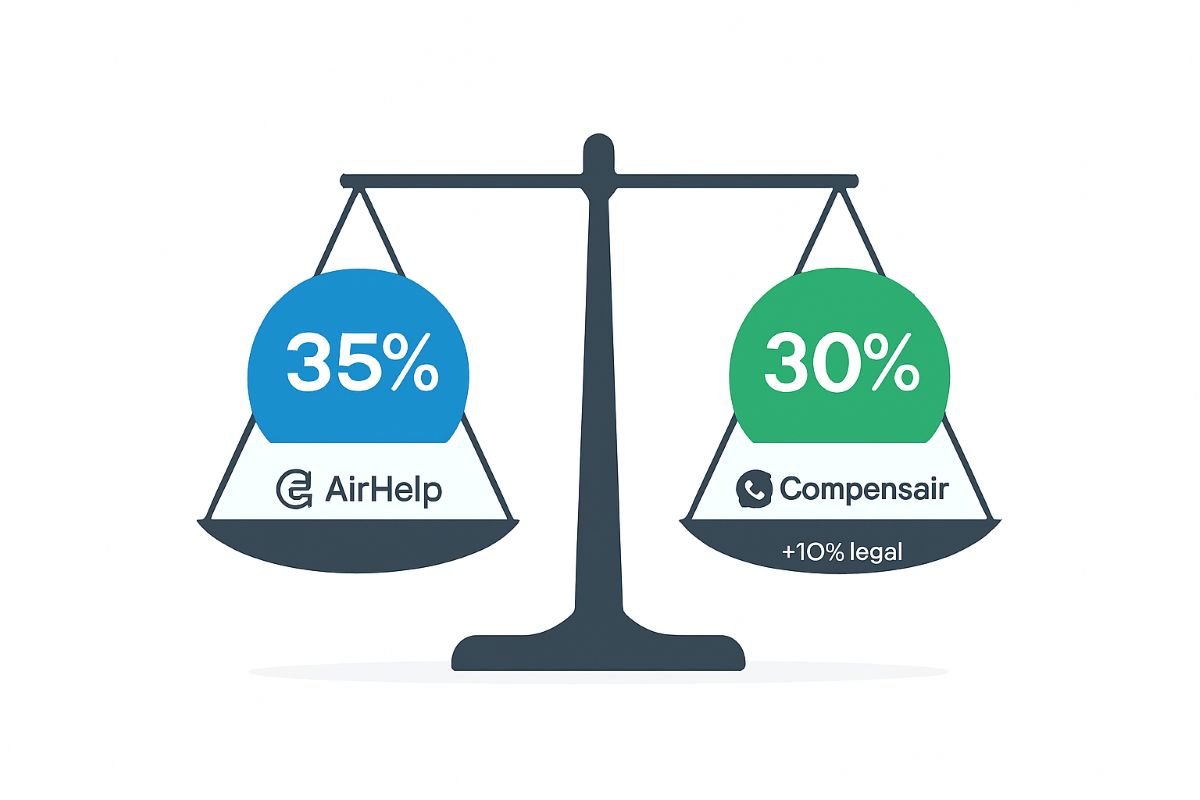
AirHelp runs a larger, more tech-driven operation with a broad global footprint. Its fee is approximately 35% of the payout. That scale shows up in legal reach and automation, which can matter in cross-border or unusually complex disputes.
Compensair positions itself with a lower base fee—about 30%—and a contingent 10% legal fee if formal legal steps become necessary. It often earns praise for speed and direct, human communication, including channels like WhatsApp.
Different strengths suit different travelers. International flyers juggling multi-leg itineraries will likely value AirHelp’s global legal capability. Those dealing mainly with European delays and cancellations may find Compensair’s responsiveness and cost structure appealing.
Fees can change. Always check current terms before you sign.
How “No-Win, No-Fee” Flight Compensation Works
The model is straightforward: you authorize a claims company to pursue compensation from an airline on your behalf. If the case succeeds, the company takes a cut of the payout. If it fails, you pay nothing.
This removes upfront risk for the passenger. The trade-off comes later—through the commission. The company invests time, expertise, and in some cases legal filings. Your cost is contingent on success rather than on hours billed.
The process typically starts with submitting flight details and any supporting documentation. From there, the service tests eligibility under applicable regulations and airline obligations. For cases that stall, the company can escalate with legal partners if the facts and law support that step.
One line summary: no result, no fee.
Fee Structures and the True Take-home Amount
Headline percentages matter less than the final amount landing in your bank account. A simple way to think about it is to model outcomes under different paths.
AirHelp’s structure is approximately 35% of the recovered amount. If a case pays €600, your estimated net is €390 after the commission. If the case pays less, the absolute fee drops proportionally, because it is percentage-based.
Compensair applies an approximate 30% base fee. On a €600 outcome, your net would be about €420 if the claim resolves without legal escalation. If the case requires a legal step, an additional 10% legal fee may apply, reducing the net to around €360.
The complexity is obvious: a lower base fee can still result in a higher total fee if the case moves into the legal track. Conversely, a streamlined resolution can keep more money in your pocket under Compensair’s structure.
A brief reminder: fee schedules can change without notice. Check the latest numbers directly.
AirHelp Fee Model and When It Applies
AirHelp’s fee is presented as an approximate 35% of the final compensation. That rate applies when the company wins on your behalf. The information provided does not split out a separate legal fee, which suggests the quoted rate covers the end-to-end service.
This structure aligns with AirHelp’s operational posture. The company emphasizes technology, automation, and a broad legal network. If a claim crosses borders, involves complex jurisdictional questions, or requires escalation, the integrated approach becomes an asset. You pay one percentage and the process moves forward without additional fee layers disclosed in the source material.
It’s a clean message, even if the percentage is higher than some alternatives.
Compensair Fee Model and When the Legal Fee Triggers
Compensair markets an approximate 30% base fee that applies upon a successful outcome. The nuance is the potential 10% legal fee. That extra cost appears when a case requires legal action to get results—think formal letters from lawyers, court filings, or similar steps.
In straightforward scenarios, passengers benefit from the lower base fee. If escalation happens, the total charge can meet or exceed AirHelp’s single-rate model. That is the trade-off. For many European delay or cancellation cases that resolve through negotiation, the 30% base can be appealing.
Communication style is a differentiator. Compensair is noted for direct contact, including WhatsApp support. For travelers who want regular human updates, that matters.
Speed and Communication Experience
Compensair is often described as faster, with a hands-on communication approach. The company provides direct contact options that help reduce uncertainty for travelers waiting on an outcome.
AirHelp runs a highly automated process. That can mean fewer ad hoc updates and more status dashboards or periodic notices. Some passengers prefer automation; others value real-time chat access and the personal touch.
Fast is relative. Airlines control many timelines. Even “faster” services don’t override airline response calendars or legal deadlines.
Patience is still required.
Processing Timelines and Expectations
The fine print most passengers overlook is the time factor. Even efficient services can face long waits for airline responses, document verification, or legal scheduling. Cases can run 20+ weeks. Not because the claims company is idle, but because counterparties and courts move slowly.
And complexity adds time. Multi-leg itineraries, carriers based outside the EU, or disputed liability can extend the calendar significantly. If your priority is sheer speed, no outsourced service can guarantee it. Timelines are largely dictated by third parties and the legal system.
Set expectations early. Waiting months is common.
Direct Support Channels and Responsiveness
Compensair’s communication approach includes direct, conversational channels like WhatsApp. That can defuse anxiety. You can ask a question and often receive a concise answer from a human.
AirHelp uses automation to keep you informed at milestones. The benefit is consistency and scale. The drawback is that it may feel less personal for passengers who want frequent, unscripted updates.
Neither approach is universally better. It depends on the traveler’s preference for communication style and how much hand-holding they want during a lengthy process.
Short message: choose the style you can live with for months.
Legal Reach and Capability in Complex Claims
AirHelp’s wider global presence and described legal reach align with complex, international cases. When a claim touches multiple jurisdictions or requires cross-border legal coordination, the company’s network and experience reduce friction.
Compensair is described as a strong alternative. The presence of a separate legal fee indicates the service will escalate when needed. For cases squarely within European regulations and routes, that may be more than enough.
The distinction isn’t about competence. It’s about infrastructure depth for complex scenarios.
International Versus European Focus and Regulatory Fit
The biggest practical fork is the route profile. AirHelp is generally better for complex international claims. That includes multi-country itineraries or claims with non-EU carriers where jurisdictional questions can slow progress. In these situations, a broad legal footprint can be decisive.
Compensair is competitive for European flight issues. If your travel is primarily within Europe and the facts are clear—significant delay, cancellation, or denied boarding—Compensair’s combination of direct communication and the lower base fee can be compelling, particularly when cases settle without legal escalation.
Match the service to the likely regulatory framework for your trips.
Technology, Automation, and Ease of Use
AirHelp highlights a tech-forward approach, including AI-driven workflows and automation. That should translate to a smooth intake process, consistent status tracking, and standardized escalation triggers. For passengers who prefer self-serve interfaces and clear dashboards, this is attractive.
Compensair leans into speed and direct communication. The experience may feel more conversational and human-guided. For some travelers, that is more reassuring than a portal, especially when a claim stretches over many weeks.
Both claims start similarly: you submit flight details, consent to representation, and await updates. The difference lies in how those updates arrive and how tightly the process is automated.
Reputation, Scale, and Trust Signals
AirHelp has worked with more than 16 million passengers, a scale that signals staying power and process maturity. That kind of volume typically correlates with robust systems and a deep bench of legal partners.
Compensair shows solid marks on service and speed notes, with references to good processing outcomes. The branding is more about responsiveness than mass scale, which will please a different segment of travelers.
Both operate under a no-win, no-fee promise. That aligns incentives with passengers and reduces upfront anxiety. But the commission still matters at the end, so scrutinize the terms you sign.
Which Service Fits Which Traveler Profile
Picking a provider turns on your routes, your tolerance for automated vs human contact, and your sensitivity to fee structures that may change with legal escalation.
You can’t optimize for every factor. Choose the trade-offs that suit your travel pattern.
Frequent International Flyers with Complex Itineraries
If your trips cross regions and involve mixed carriers or tight connections, AirHelp’s larger, tech-led, global operation is well matched. The roughly 35% fee buys you integrated handling and broad legal reach, which can streamline tough cases that might otherwise stall.
Consistency matters here. You need a provider comfortable with complexity and escalation.
Primarily European Travelers with Straightforward Delays or Cancellations
If most of your flights are within Europe and your claims tend to be clear-cut, Compensair’s lower base fee and direct communication style are attractive. When cases resolve without legal steps, you keep more of the payout compared with higher flat-percentage models.
Add the practical benefit of WhatsApp support. Many travelers value that personal contact.
Risks, Caveats, and How to Decide Today
A few realities deserve attention. First, fees and policies can change. The percentages quoted are approximate and subject to updates. Always review current schedules on the provider’s site before agreeing.
Second, timelines are long. Even with a responsive team, airlines and courts move slowly. Cases may take 20+ weeks. If a provider promises ultra-fast outcomes across the board, treat that as marketing rather than a guarantee.
Third, legal escalation affects cost. Compensair’s extra 10% legal fee is contingent; if your case escalates, your net changes. AirHelp’s single percentage simplifies planning but at a higher baseline.
Finally, pick for fit. Consider the routes you fly most, your communication preferences, and the likelihood of legal steps. If in doubt, get a feel for both portals. Submit a preliminary claim and compare the experience before committing.
Keep your decision pragmatic.
Bottom Line Recommendation
For travelers tackling cross-border, complex claims, AirHelp’s broad legal reach and automated process make sense, even at an approximate 35% fee. For travelers focused on European delays or cancellations, Compensair’s 30% base fee plus contingent 10% legal fee, coupled with direct communication, can be a better value when cases resolve without escalation.
Both are credible. Both remove upfront risk. Pick the model that matches your routes, your patience for long timelines, and your preferences for human vs automated updates.
Then commit and let the process run.