 What SimOptions Is and How Its eSIM Marketplace Works
SimOptions runs a marketplace where travelers can purchase eSIM data plans from multiple mobile operators. Instead of visiting a carrier store or waiting for a physical SIM, you buy a plan online, receive a QR code, and install the eSIM profile directly on your phone. That single step turns your handset into a local-ready device that can go online the moment you land.
The marketplace model matters because it puts several brands side by side. Shoppers can compare coverage areas, data allowances, validity periods, and price points without juggling multiple carrier sites. SimOptions curates the plans, processes payment, and delivers activation details securely. Support and documentation are centralized, which reduces guesswork for first-time eSIM users.
In short, it’s a storefront for digital connectivity. Pick a brand, pick a plan, scan, and go.
Why Travelers Choose eSIM over Physical SIM
Convenience leads the list. An eSIM can be installed before departure, so your device connects immediately. No vending machines. No kiosks. No micro or nano SIM punching.
There is also flexibility. Many phones can hold multiple eSIM profiles, letting you keep your home number active for calls and texts while using a travel data plan for apps and maps. Switching between profiles usually takes a few taps in settings.
Security plays a role. A digital profile cannot be physically removed if your phone is lost. And because the purchase is completed online, there is less exposure to street vendors and unverified sellers.
Cost control helps too. Regional or country-specific data plans often undercut standard roaming charges from home carriers. Prepaid bundles keep spending visible.
The Brands Available on SimOptions
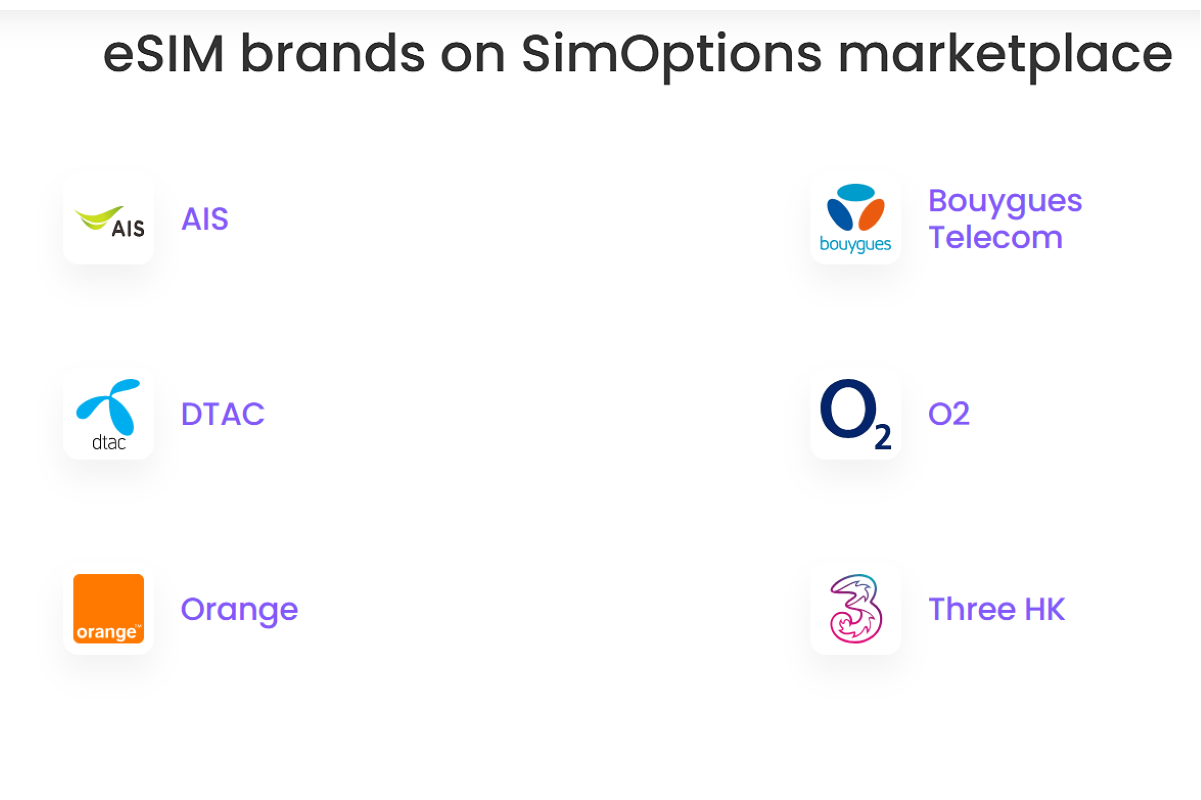
SimOptions lists plans from well-known mobile operators. Based on the provided site content, these include AIS, Bouygues Telecom, DTAC, O2, Orange, and Three HK. Each brings its own coverage footprint and plan structure.
AIS
AIS is a major Thai operator. On marketplaces, AIS plans typically focus on Thailand coverage, sometimes with options that include neighboring Asian destinations. Data allowances vary from short-stay bundles to higher-capacity options for longer trips.
If your itinerary centers on Bangkok, Chiang Mai, Phuket, or the islands, AIS is frequently a solid pick. The network has wide national reach and reliable speeds in urban areas.
Bouygues Telecom
Bouygues Telecom operates in France and participates in European roaming zones under EU rules for eligible plans. On eSIM marketplaces, Bouygues offerings commonly serve travelers who want data in France, sometimes with usage in other EU countries depending on plan terms.
Paris, Lyon, Marseille, or Bordeaux—city travel is straightforward, and many plans support hotspot use. Always confirm the fair use policy for roaming within the EU.
DTAC
DTAC, another Thai carrier, provides domestic Thailand eSIM plans and may feature travel bundles tailored to visitors. Coverage within major tourist corridors is strong, and pricing can be attractive for budget-conscious trips.
If you expect to stream navigation, book ride-hailing, and keep social media updated, DTAC plans with moderate to high data allotments can be a match.
O2
O2 is a prominent brand in the UK and has a presence across several European markets. O2 eSIM plans on marketplaces often include UK coverage with allowances that may extend to EU usage, subject to plan specifics and fair use limits.
For multi-city tours across London, Manchester, and onward to EU capitals, O2 can simplify connectivity across borders. Always check the roaming inclusion list.
Orange
Orange is widely recognized in Europe and beyond. Marketplace eSIMs from Orange often target pan-European travel, and some products cover broader regions with multinational roaming. The brand is known for reliable networks in major cities and tourist areas.
Travelers who prefer a single plan across several countries often start with Orange portfolios. Terms differ by product, so read the list of supported countries closely.
Three HK
Three Hong Kong typically offers regional Asia or global travel eSIMs that aggregate roaming partnerships into one package. These plans can appeal to travelers hopping across multiple countries in quick succession.
If you are flying from Hong Kong to Tokyo, then on to Seoul or Singapore, a Three HK travel eSIM may keep things simple. Country lists and throttling rules are the key details to verify.
Regional Coverage and Typical Use Cases
Single-country plans focus on one destination with competitive data rates and straightforward setup. They are ideal for city breaks and resort stays where you won’t cross borders.
Regional plans cover a cluster of countries such as the EU/EEA, Southeast Asia, or East Asia. These help on multi-country itineraries where border crossings would otherwise require plan swaps.
Global plans serve travelers who span continents on a single trip. You pay for breadth, not depth. Speeds and fair use rules can vary by country.
Short trip? A 3–7 day plan with modest data often suffices. Digital nomad month? Look at 30-day plans with higher data caps or top-up capability.
Plan Features to Compare Across Brands
– Data allowance and speed: Check the gigabytes included, speed caps, and any throttling triggers.
– Validity period: Confirm plan duration from activation or first use. Some countdowns start on installation; others start on first connection.
– Coverage list: Read the country list and the type of access (4G, 5G where available).
– Hotspot support: Tethering rules differ. Some brands restrict hotspot use or set separate limits.
– Voice and SMS: Many travel eSIMs are data-only. If you need calls or texts, look for add-ons or use VoIP apps.
– APN and settings: Some plans auto-configure. Others require manual APN entry.
– Top-ups and extensions: Flexibility to add data can spare you from buying a new eSIM mid-trip.
– Customer support: Centralized marketplace support plus brand documentation is helpful for troubleshooting.
Activation Steps and Device Compatibility
Activation is usually straightforward:
1) After purchase, you receive a QR code and sometimes a manual activation code.
2) On your phone, open eSIM settings, choose “Add eSIM” or “Add cellular plan,” and scan the QR.
3) Label the line (for example, “Travel Data”) and set data and roaming preferences.
4) Some plans need you to enable data roaming on the eSIM line to connect abroad.
5) If data does not flow, enter the APN settings provided in your plan instructions.
Compatibility depends on your device. Most recent iPhones support eSIM, including many models from XS/XR onward. Many Google Pixel phones and Samsung Galaxy models also support eSIM. Check your exact model and carrier lock status. A locked device may not accept non-home plans, even as eSIM.
Install before you fly if possible. This gives time to test on home Wi‑Fi and confirm the profile loads correctly.
Pricing Patterns and Ways to Save
Pricing scales with three factors: data volume, validity days, and coverage breadth. Single-country plans with 3–10 GB over a week often sit at an affordable price point. Regional and global bundles cost more per gigabyte due to roaming arrangements.
Several practical tactics can trim costs:
– Match the plan to your actual data needs. Overbuying data is common.
– Use offline maps and pre-download media over hotel Wi‑Fi.
– Prefer regional plans only if you will cross borders. If you stay within one country, a local plan is usually better value.
– Track usage in your phone settings to avoid surprise throttling.
– Look for seasonal sales. Marketplaces sometimes run limited-time discounts.
– Consider two smaller plans if your trip splits across weeks. This may reduce unused days.
Tiny tip: turn off background refresh for heavy apps during the trip.
Roaming, Hotspot, and Fair Use Considerations
Roaming rules define where your plan works and at what speeds. Even “global” plans may exclude a handful of countries or use 3G in remote areas. Always check the operator’s country list inside the product page.
Hotspot policies vary. Some carriers allow tethering freely, others restrict it or meter it differently than on-device data. If your laptop work relies on tethering, verify this point before checkout.
Fair use policies protect networks from sustained high consumption that can degrade service. After crossing a threshold, you may see speed reductions or partial restrictions. Many travel plans state the exact threshold; keep an eye on it if you stream video or upload large files.
How to Choose the Right eSIM for Your Itinerary
Start with your route. Single-country plan for a city trip, regional plan for border-hopping, global plan for multiple regions.
Next, size your data. Estimate maps, ride-hailing, messaging, and occasional video calls. A typical traveler often uses 1–3 GB per week for maps and social media, more if streaming. Add a buffer.
Check the brand’s strength where you will spend the most time. AIS or DTAC in Thailand, Bouygues in France, O2 and Orange for broader European travel, Three HK for multi-country Asia or wider roaming. This alignment reduces surprises.
Confirm device compatibility and lock status before purchase. If your phone is carrier-locked, address that first.
Finally, scan the fine print: hotspot policy, activation timing, refund terms for failed activation, and whether top-ups are supported. A few minutes of review can prevent mid-trip friction.
One more thing: install over Wi‑Fi for a smooth setup.
Key Takeaways for Buying an eSIM on SimOptions
– SimOptions aggregates multiple carriers, including AIS, Bouygues Telecom, DTAC, O2, Orange, and Three HK, so you can compare plans in one place.
– Choose plan scope by itinerary: single-country for depth, regional for cross-border trips, global for multi-region travel.
– Verify data allowance, validity, hotspot support, and fair use thresholds before checkout.
– Ensure your device supports eSIM and is unlocked; install the profile on Wi‑Fi and test settings.
– Control costs by matching data to real needs, using Wi‑Fi for heavy downloads, and monitoring usage.
– Keep an eye on roaming country lists and network technology notes to avoid coverage gaps.
– Prefer brands with strong networks where you’ll spend most of your time.
Simple steps, fewer surprises, reliable connectivity on arrival.
Travel ready, phone ready, plan ready.